
EDreframe
Educational Consultancy
for AI-Enabled Learning
© EDreframe. All rights reserved.
Helping institutions prepare learners for an AI-enabled world .
For universities, schools, language providers, NGOs, and organisations exploring AI-enabled learning.
PROjects is EDreframe's flagship project-based learning framework that develops transferable skills through real-world projects and challenges.
How we help institutions
✓ Design project-based programmes
✓ Redesign assessment
✓ Integrate AI meaningfully
✓ Develop teachers
Through consultancy, curriculum design, pilots, workshops, and implementation support.
Why EDREFRAME exists
EDreframe is a learning design studio that helps institutions redesign learning for a world shaped by AI, communication, and real-world problem-solving.We develop project-based programmes, assessment approaches, and teacher development systems that make learner thinking, collaboration, and decision-making more visible in AI-supported learning environments.


What we design
- AI-integrated project-based programmes
- Visible-thinking assessment approaches
- Communication-focused learning tasks
- Teacher development and implementation support
- Pilot-ready learning units and frameworks
HOW IT CAN BE IMPLEMENTED
EDreframe programmes can be implemented as:- pilot courses,
- curriculum enrichment,
- intensive short programmes,
- teacher development initiatives,
- extracurricular innovation pilots,
- foundation or pathway support,
- communication and employability modules.Programmes can be adapted for universities, language schools, NGOs, ministries, and workplace learning contexts.
EXAMPLE LEARNING TASKS
Example learner tasks include:* podcast production,
* documentary-style projects,
* presentations and investor pitches,
* collaborative problem-solving tasks,
* AI-supported debate preparation,
* structured reflection and decision justification activities.
WHAT INSTITUTIONS RECEIVE
Depending on the collaboration format, institutions may receive:• Curriculum
• Assessment tools
• Teacher training
• Implementation support
• Evaluation.

WHAT PROjects IS
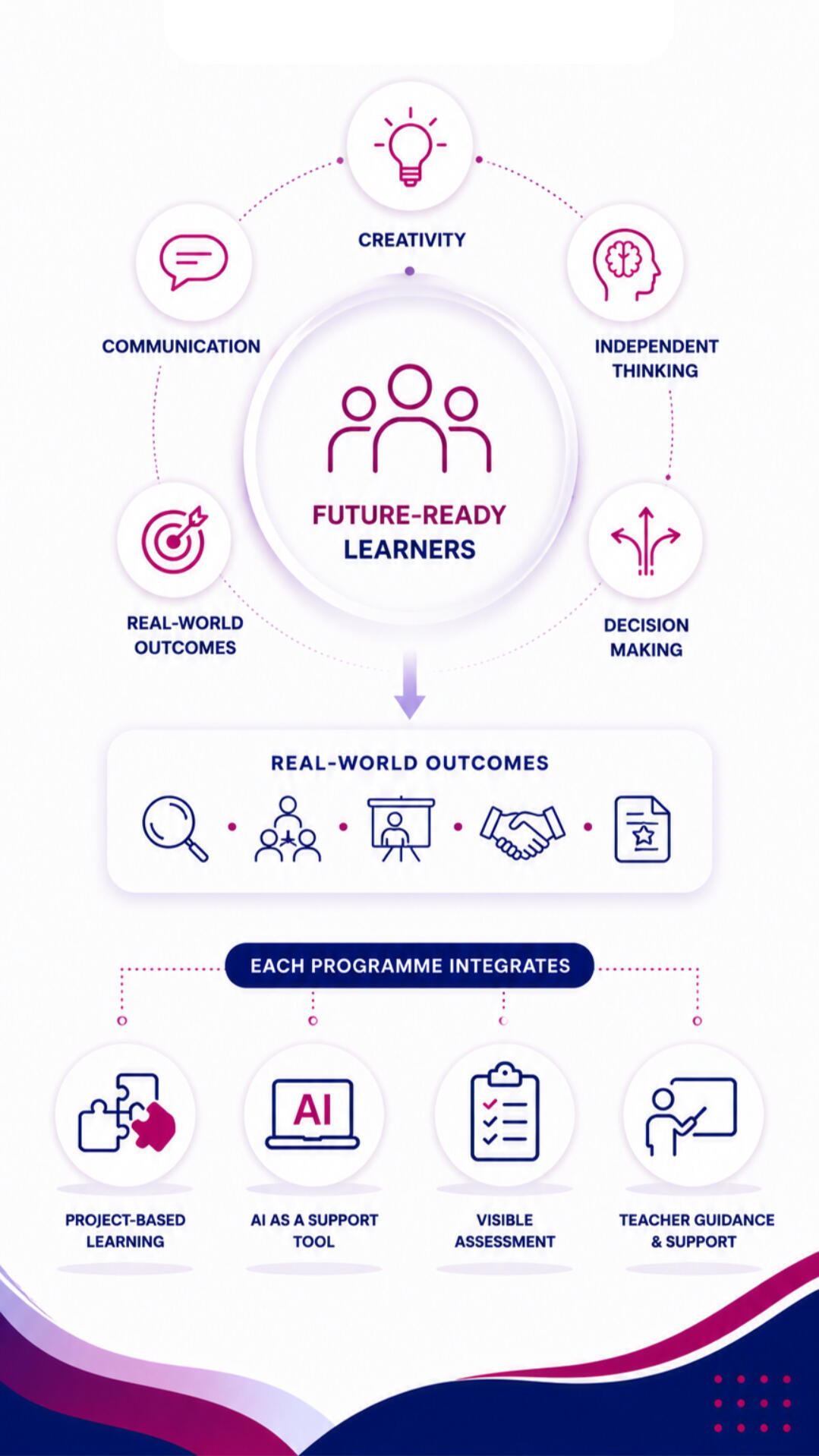
PROjects is a structured, project-based programme framework that develops communication, independent thinking, creativity, and decision making through authentic real-world projects.English serves as the working language through which learners research, collaborate, present ideas, negotiate decisions, and produce meaningful outcomes.Rather than focusing only on classroom performance, PROjects is designed to make learner thinking, communication, and decision-making more visible through structured projects and clear assessment criteria aligned with skills increasingly required in higher education and the modern workforce.Each programme integrates:* project-based learning
* AI as a support tool for thinking and language development
* visible assessment linked to real-world outcomes
* teacher guidance and implementation support

WHAT BECOMES VISIBLE
Projects create stronger evidence of learners’:- communication and collaboration- reasoning and decision-making- problem-solving and adaptation- responsible use of AI- ability to apply learning beyond the classroom
REAL-WORLD LEARNING OUTPUTS
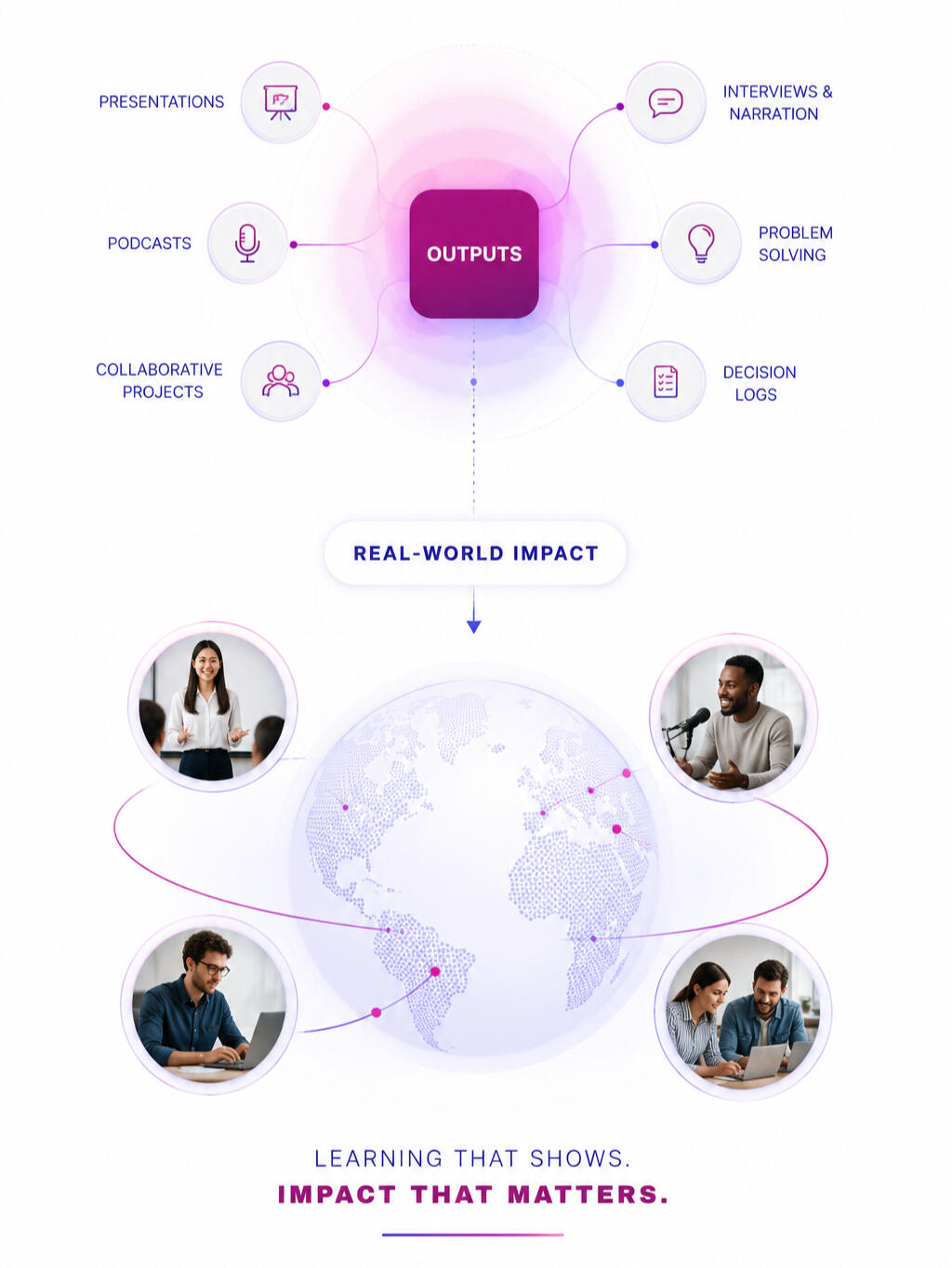
Learners produce visible, outcome-driven work connected to real-world communication, collaboration, and decision-making.Outputs include:• podcast episodes with structured viewpoints
• documentary-style interviews and narration
• persuasive presentations and investor pitches
• collaborative problem-solving projects
• reflective AI-supported decision logs
• public-facing communication tasksEach output is assessed through clear criteria linked to communication, reasoning, collaboration, and real-world language use.
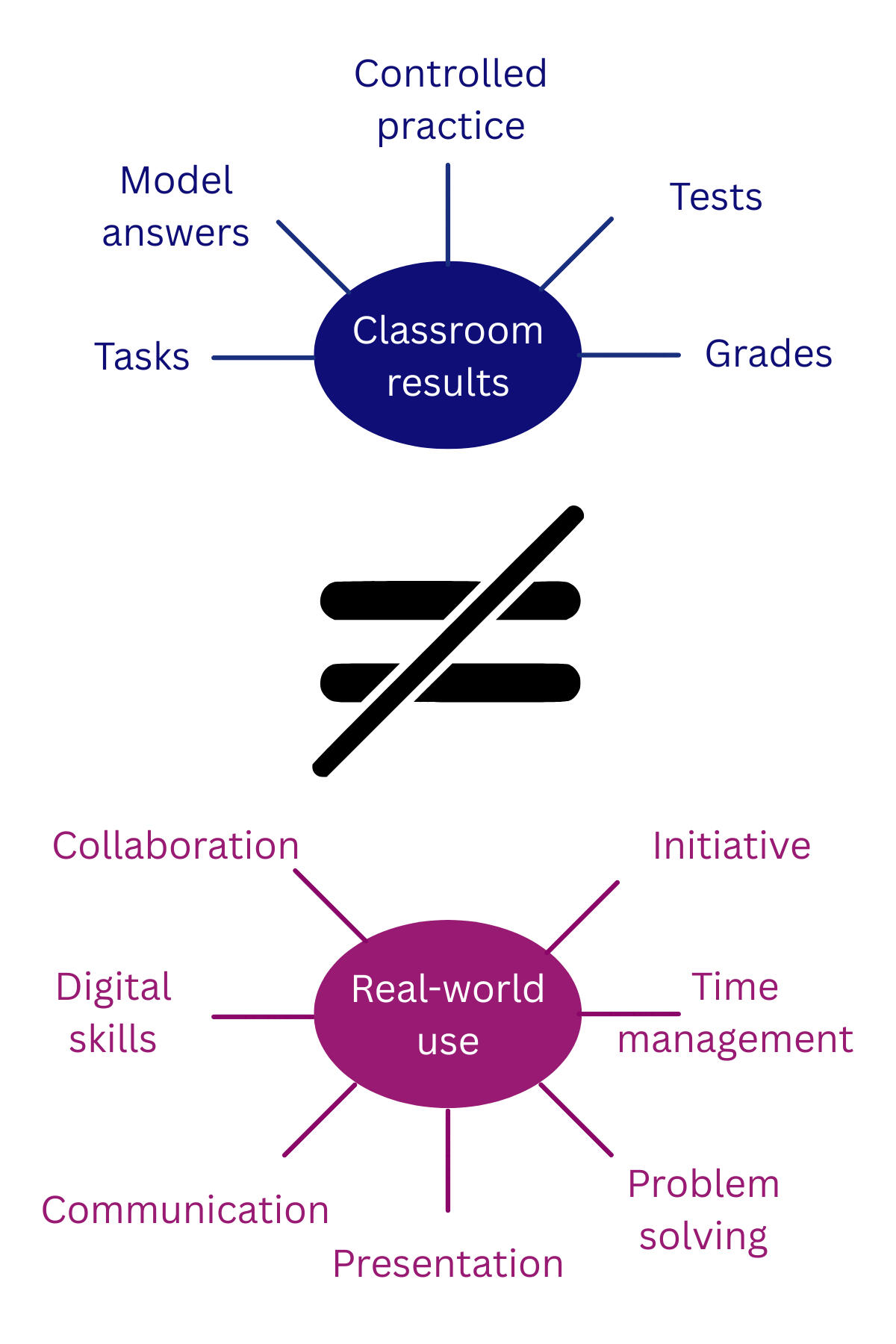
Strong classroom results don’t guarantee real-world use
Students can complete tasks, follow models, and participate in class, but struggle to apply what they’ve learned independently.At the same time:- AI is increasingly used as a shortcut rather than a thinking tool- Teachers are adapting, but without clear structures- Schools are under pressure to differentiate, without a clear directionThe result: performance in class does not translate into real-world capability.
Beyond task completion
Most educational programmes successfully help learners complete classroom tasks. However, completing tasks does not necessarily mean learners can apply what they have learned in unfamiliar, real-world situations.Many learning experiences emphasise correct answers, content coverage, and task completion, while giving less attention to communication, collaboration, problem-solving, decision-making, and the ability to transfer these capabilities across different contexts.PROjects is designed differently. Through authentic, project-based learning, earners solve meaningful problems, collaborate with others, make informed decisions, and create outcomes with real-world relevance.PROjects is designed to develop skills (including communication, collaboration, problem-solving, and decision-making) that transfer beyond the classroom.AI supports thinking, research, and feedback, while assessment focuses on authentic performance rather than task reproduction. English serves as the working language through which learners communicate, collaborate, and present their ideas throughout the programme.
Implementation
How we work
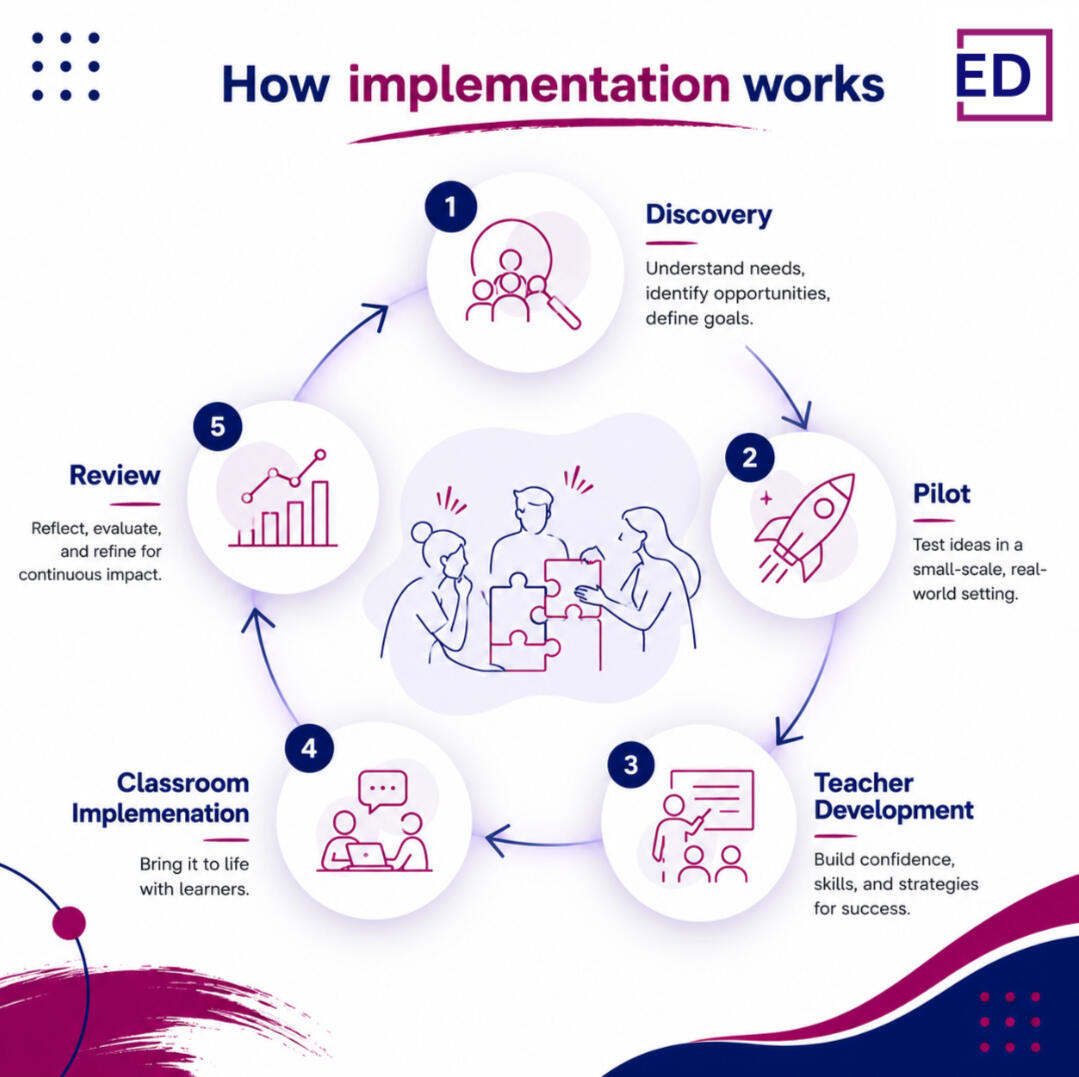
1. Identify a relevant challenge with the institution and, where appropriate, external stakeholders.2. Design a curriculum-linked project, learning materials and assessment approach.3. Prepare educators to facilitate the work.4. Pilot the project with learners.5. Review outcomes and refine the programme.
What institutions receive?
Secure access to the EDreframe online platform
Ready-to-use project-based learning units
Learner activities and resources
Assessment rubrics and reflection tools
Responsible AI integration guidance
Teacher training and implementation support
Ongoing updates throughout the licence period
Questions Asked By Institutions
How is this different from ordinary project-based learning?
| Traditional projects | EDreframe's PROjects |
|---|---|
| Often optional | Integrated into learning |
| Product-focused | Thinking process visible |
| Limited assessment | Performance assessment |
| AI rarely addressed | AI integrated responsibly |
| Teacher creates materials | Structured online materials + support |

How much work is this for teachers?
Very little. EDreframe provides ready-to-use online learning materials, assessment tools, and implementation support. Teachers receive training before implementation and ongoing guidance throughout the programme.
How are learners assessed?
Assessment focuses on authentic performance using clear , predefined criteria. Learners demonstrate what they can communicate, create, justify, and apply in real-world contexts.
Where does English fit?
English is the working language through which learners collaborate, communicate ideas, justify decisions, and present outcomes. The programme develops transferable capabilities while strengthening English through meaningful use.
How is AI used?
AI is used to support research, thinking, language development, and reflection. Learners remain responsible for making decisions, creating solutions, and justifying their work.
How do institutions access PROjects?
Following the pilot or licence agreement, teachers receive access to EDreframe's online platform, where all programme materials, learner activities, assessment tools, and implementation resources are available.
Can PROjects be adapted to different institutions?
Yes. Projects, themes, and implementation can be adapted to different ages, contexts, curricula, and institutional priorities.
EXPERIENCE & CREDIBILITY
Sondes Gharbi - Founder, EDreframe- 15+ years experience in ELT and academic leadership- Academic leadership experience at the British Council and British Study Centres- Conference speaker (IATEFL, University of Oxford)- Presenter and contributor in international AI and education discussions (IATEFL, AIEOU at University of Oxford)- Accredited ELT Council trainer

COLLABORATION
EDreframe is open to commissioned pilots, programme-development work, and Erasmus+ Cooperation Partnerships.We work with reliable and trustworthy partners who value accountability, transparent communication, clear responsibilities and shared commitment to meaningful outcomes.
EDreframe can contribute- Curriculum and project design
- Learner materials
- Assessment tools
- Responsible-AI guidance
- Teacher and facilitator development
- Piloting and evaluation


Interested in exploring a project in your context?
What we offer
Curriculum redesign
PROjects implementation
Assessment redesign
Teacher development
Responsible AI integration
Teacher & facilitator development
PROjects implementation
Pilots
Who we work with
Language providers
Schools
Universities
NGOs
Government entities
Human resrouces (HR) and Learning & Development (L&D) departments
How would we work together?
| 1. | Discovery | Understand the organisation, learners / users, priorities and context.. |
| 2. | Scope and design | Agree what needs to be developed, redesigned or implemented. |
| 3. | Preparation | Develop materials and prepare the people involved. |
| 4. | Implementation | Deliver, pilot or support implementation. |
| 5. | Review | Evaluate outcomes and plan next steps. |
Articles
If AI reduces entry-level work, what are universities certifying?
Written by Sondes Gharbi
After attending IATEFL, one idea kept resurfacing across several sessions. AI is expected to reduce entry-level white-collar tasks, many of which have traditionally been carried out by interns or junior employees. According to the World Economic Forum, entry-level roles in the US have already declined by around 35% in some sectors, reflecting early shifts in how organisations structure junior work. (link below)If that is the direction of travel, universities face a more immediate question: what exactly are we certifying when a student graduates, and how do we know it still holds value?If output can be produced without ownership of thinking, then grades risk reflecting performance rather than competence. That creates uncertainty about what a degree actually proves.AI has made it significantly easier to produce strong output: well-organised arguments, clear structure, accurate language. On the surface, the quality is there, but the link between output and understanding is no longer guaranteed. This creates a structural problem for universities. It is not marginal as it affects the reliability of assessment decisions across modules, programmes, and awards.Assessment has traditionally relied on what students produce: essays, reports, presentations. These have been treated as evidence of thinking, not just language or structure. That assumption is now unstable because students can produce without fully owning the decisions behind what they submit.This is not simply about misuse of AI. It exposes a gap that was already there: many academic tasks were designed around completion rather than visible thinking. Students follow the structure, meet the criteria, and submit the work. As long as the output looks right, the process often remains hidden. AI has made this gap impossible to ignore.This is not only a classroom issue since it challenges the validity of assessment as a whole. If output can be generated without ownership of thinking, then the link between grades and actual competence becomes unstable.The response so far has focused on control: restricting tools, using detection software, and asking students to declare AI use. These approaches may slow things down, but they do not address the core issue. They still assume that output can be trusted as evidence.The needed change is not about removing AI from the process, but about redesigning the process itself. In an AI-mediated context, learning must be evidenced through decision-making and justification, not output alone. This is a shift in how learning is evidenced, observed, and evaluated across programmes, not a simple pedagogical adjustment at the level of individual lessons.If students can generate answers, the value lies in the process: how they arrive at them, how they adapt them, and whether they can stand behind them. This requires fewer, higher-stakes tasks where thinking is made visible through decision points, justification, and adaptation.In this kind of environment, AI does not replace thinking, but it makes it visible. It becomes clear whether a student understands what they are doing, or is simply producing something that works on the surface.The question for universities is whether current task and assessment design can still capture learning in a context where output is easy to generate. If it cannot, then strong work is no longer reliable evidence of competence. This has implications far beyond the classroom.If evidence is unreliable, consistency in marking, external moderation, and the credibility of awards are all put under pressure. If universities cannot demonstrate that student work reflects genuine understanding, the signalling value of a degree is weakened because the evidence used to award it is no longer reliably tied to demonstrated competence.This raises a broader question for universities: if thinking must be visible, how is it captured consistently across modules, assessed reliably across markers, and validated at programme level? Without this, improvements at task level remain isolated and the underlying issue of evidence does not change.In an AI-mediated environment, the focus shifts. Not just on what students produce, but on whether they can explain it, adapt it, and take ownership of it. The ability to produce an answer is becoming common. The ability to stand behind it is not.If this change is required, universities will need to redesign how evidence of learning is generated, assessed, and validated at scale so that claims of competence are grounded in observable, defensible thinking.
When learning stops being supervised: why AI calls for a new kind of trust in ESL
Written by Sondes Gharbi
The myth of measurable learning
For decades, policymakers have treated learning like a checklist; observable, assessable, and reportable. If it can’t be measured, it doesn’t count. That belief shaped how teachers planned, how students behaved, and how institutions justified progress.But as AI enters the classroom, that equation collapses. What once defined “supervised learning” (a teacher marking a task against a standard answer) no longer captures what learning is. AI doesn’t obey our marking schemes. It opens questions we can’t anticipate. It rewards curiosity more than compliance. That is precisely why measurable learning can no longer be our only measure of education.
Supervision without control
Before AI, supervision meant observation: formative feedback, summative marks, and the silent pressure to finish on time. It was order, predictability, and safety. Now, when a learner types a question into ChatGPT or Grammarly, the teacher isn’t supervising anymore, the learner is.Supervision is shifting from an external system of control to an internal system of reflection. The student becomes their own supervisor: questioning, checking, interpreting. AI becomes a mirror of their reasoning, not a substitute for it. This doesn’t mean abandoning structure. It means shifting it. The unit objectives, criteria, and milestones still matter, but they exist to keep learners oriented, not restricted. The real supervision now happens when a learner pauses and asks: How did AI’s answer shape my understanding? That moment (not the exam mark) is the new evidence of progress.
When AI is wrong, learning is right
Mistakes used to be the teacher’s domain. Now AI makes them too. The instinct is to panic; “What if students learn misinformation?” But the deeper question is: what if that error becomes a catalyst for deeper thinking?Students learn best when they wrestle with uncertainty. Discovering that AI got something wrong, and then tracing why, builds exactly the kind of cognitive resilience language education has always aimed for. As I often remind teachers: We don’t learn from smooth seas. We learn to sail through rough waters.When students correct AI, they’re not just learning English, they’re learning discernment. They’re training themselves to think, not just to trust.
When unsupervised becomes unsafe
There are limits. Unsupervised learning becomes counterproductive when learners disconnect completely, when curiosity turns into distraction, or when a student stops engaging meaningfully with ideas. At that point, supervision doesn’t need to return to control; it needs to extend to care. Other professionals, mentors, or systems may need to step in. AI can’t replace that human layer of empathy and presence and it shouldn’t try to.
A small shift teachers can make tomorrow
Moving from supervision to co-supervision doesn’t require an overhaul. It begins with transparency:- Make the assessment criteria visible from day one.
- Define the end task, timeline, and checkpoints clearly.
- Let students know how, when, and where to ask for support.What skill did I gain from this task that I’ll use beyond this classroom?This question alone reframes learning from compliance to connection.
Teaching students to supervise AI
Ethically, this is where the teacher’s role deepens, not diminishes. We’re not teaching them how to use AI, we’re teaching them how to supervise it. Fact-checking, questioning, and self-reflection become literacy skills in their own right. Responsibility replaces obedience.AI mirrors the learner’s thought process: their biases, gaps, and curiosity. When a student reads an AI-generated response, they’re effectively reading a reflection of their own question quality. Helping them see that mirror clearly, without judgment, is where the true supervision happens.
English as a medium, not a subject
In this approach, English stops being the topic of learning and becomes the tool for it. When students create, present, or record their projects in English, the language isn’t studied; it’s lived. It becomes the vehicle for inquiry, creation, and collaboration, the bridge between curiosity and clarity. That’s where long-term retention happens: not through memorization for exams, but through authentic use in meaningful contexts.
From fear to trust to design
AI unsettles us because it exposes how little of learning was ever about thinking. Most of it was about control. But when teachers begin to design learning (not just deliver it) supervision evolves into something more powerful: shared responsibility.Policymakers must now abandon the idea that learning only counts if it’s measurable because the most valuable learning (the kind that turns a student into an autonomous thinker) can’t always be counted. It can only be witnessed through trust, curiosity, and design.
This article was developed through an AI-supported writing process, reflecting the same principles discussed throughout the piece: using AI not as a replacement for thinking, but as a tool for reflection, refinement, and idea development.
Education Cannot Stop at
Knowledge Consumption
Written by Sondes Gharbi
From Knowledge Consumption to Passive Participation
There is a growing contradiction at the heart of modern education. Many learners today can explain global problems in remarkable detail. They can discuss climate change, inequality, misinformation, artificial intelligence, mental health, and economic instability using increasingly sophisticated language and terminology. They can summarize articles, repeat theories, and reference concepts they have studied in classrooms for years.Yet far fewer have been trained to actively respond to those problems. Far fewer have been asked to design solutions, collaborate across disciplines, communicate ideas publicly, defend decisions, test assumptions, or build something meaningful from what they know.In many educational systems, particularly in secondary and tertiary education, learners are still primarily rewarded for consuming, reproducing, and organizing knowledge rather than applying it in visible, practical, and socially meaningful ways.
The Problem Is Not Knowledge- It Is Educational Imbalance
This is not an argument against knowledge itself as foundational and abstract knowledge remain essential, especially in early education. Primary education plays a critical role in helping learners develop literacy, numeracy, conceptual understanding, and the ability to think abstractly. The issue is not that theory exists. The issue is what happens when education stops there.As learners move into adolescence and adulthood, the balance arguably needs to change. Knowledge alone becomes insufficient if students are rarely asked to use it in contexts that resemble real life. A learner may understand the theory behind communication, leadership, sustainability, or entrepreneurship while having little experience actually negotiating with others, presenting ideas, solving ambiguous problems, or working through uncertainty collaboratively.This creates a gap between academic performance and real-world capability where many students become highly informed but professionally passive. A learner may spend years being rewarded for finding the correct answer, following predefined structures, and meeting assessment requirements, yet rarely be asked to initiate ideas, navigate uncertainty, defend decisions, or build solutions independently. Over time, these habits can extend beyond education itself. Learners may become accustomed to consuming, responding, and complying rather than actively contributing, experimenting, or creating. In very subtle ways, education can unintentionally train learners to become observers rather than participants in the world around them.This matters not only economically, but socially. Societies increasingly need people who can collaborate, adapt, communicate across differences, evaluate information critically, and contribute to solving complex problems. These abilities rarely develop through memorizing information alone. They develop when learners are asked to negotiate ideas, test solutions, communicate under pressure, respond to feedback, defend decisions, and work through unpredictable situations with others. This is partly why approaches such as project-based learning, interdisciplinary learning, and experiential education continue to gain attention internationally. These models attempt to move learning beyond isolated content acquisition toward application, communication, and visible thinking.Most importantly, this does not mean abandoning academic rigor. In fact, applying knowledge meaningfully often demands deeper understanding than reproducing it for an exam. Designing a solution, pitching an idea, conducting research for a real audience, creating a campaign, building a prototype, or solving a community-based problem requires learners to transfer knowledge rather than simply recall it.
Why Visible Thinking Matters
The rise of artificial intelligence makes this conversation even more urgent. AI increasingly exposes a structural weakness within many traditional assessment systems: if educational models mainly reward polished output, and AI tools can now generate polished output rapidly, then output alone becomes weaker evidence of learning. This does not mean learning disappears. It means the indicators of learning may need to evolve. In real-world environments, employers and institutions rarely care only about the final answer. They care about how people reached it: how they communicated, adapted, justified decisions, collaborated under pressure, and improved their thinking through feedback and reflection. The focus may increasingly move toward: decision-making, reasoning, collaboration, reflectivejustification, communication, processes, adaptability, and the ability to apply knowledge meaningfully in unpredictable situations.In other words, the challenge is no longer simply whether students can produce answers. It is whether educational systems can make learner thinking, participation, and capability more visible. This visibility matters because real-world environments increasingly depend on how people think, contribute, adapt, communicate, and solve problems with others under uncertainty. When thinking remains invisible, education risks rewarding students for reaching the finish line rather than showing how they reason, collaborate, respond to feedback, and navigate challenges along the way.
Language as a Medium for Participation and Problem Solving
This shift also changes how subjects such as English can be approached. Rather than existing only as isolated linguistic study, language can become a medium for solving problems, developing ideas, collaborating with others, and participating in real-world communication. Learners can use English to create podcasts, conduct interviews, pitch projects, debate solutions, design campaigns, or present proposals connected to authentic issues and audiences. The language remains important, but it becomes part of a larger process of participation and creation.
A Different Educational Direction
This perspective also informs the work behind initiatives such as EDreframe, which explores how project-based English programmes can make learner thinking, communication, collaboration, and decision-making more visible through real-world tasks and reflective processes.Rather than treating English primarily as isolated language performance, the approach positions language as a medium for participation, problem-solving, and capability development within increasingly AI-mediated educational environments.Ultimately, the question may no longer be whether students can reproduce knowledge. The deeper question is whether education is helping learners become people who can meaningfully apply knowledge, participate in society, adapt to changing professional environments, and contribute to solving the problems around them.
This article was developed through an AI-supported writing process, reflecting the same principles discussed throughout the piece: using AI not as a replacement for thinking, but as a tool for reflection, refinement, and idea development.
How Thinking Evolves When Working with AI

Written by Sondes Gharbi
During a recent conversation with a Senior Manager in People Consulting and Learning at EY, we discussed the kinds of capabilities people increasingly need when working alongside artificial intelligence. Although our conversation focused on the workplace, it prompted me to reflect on a broader educational question: How should thinking evolve when AI becomes part of learning?In this article, I use the term “thinking evolves” to describe the way AI shifts where and when learners engage in critical thinking. Instead of replacing thinking, AI changes the cognitive processes involved in framing problems, evaluating responses, refining ideas, and making informed decisions.For the past few years, discussions about AI in education have largely centred on whether students should use AI. Increasingly, however, this feels like the wrong question. AI is already becoming part of many learners’ everyday lives. The more important question is not whether learners use AI, but how they think while using it.When I refer to thinking evolving, I do not mean that critical thinking becomes less important. Quite the opposite. AI changes where and when critical thinking occurs. Traditionally, much of a learner’s cognitive effort was directed towards producing an answer. Today, AI can often generate a competent first draft within seconds. As a result, learners are increasingly required to invest their thinking before, during, and after interacting with AI. The educational challenge therefore shifts from producing information to framing problems, evaluating responses, refining ideas, and making informed decisions.This shift has implications far beyond education. The World Economic Forum has consistently identified analytical thinking, creative thinking, curiosity, lifelong learning, and AI literacy among the capabilities expected to become increasingly important in the workplace. Yet these should not be viewed solely as employability skills. They are equally valuable as life skills that enable individuals to navigate uncertainty, solve problems, evaluate information critically, and continue learning throughout their lives.One consequence of this shift is that learners must become more intentional when communicating with AI. This is often described as prompting, but effective prompting is not simply about learning clever techniques. It begins with clarifying one’s own thinking. Learners who struggle to explain what they need frequently receive vague or unhelpful responses, not because AI has failed, but because their own understanding of the problem remains underdeveloped. In this sense, writing an effective prompt is an exercise in critical thinking rather than a technical skill.

Context also becomes increasingly important. AI has no knowledge of the learner’s classroom, organisation, previous experiences, or objectives unless these are explicitly provided. Learning to identify relevant contextual information requires analysis, judgement, and an awareness of what factors genuinely influence a problem. Rather than expecting AI to infer missing information, learners must first understand their own context well enough to communicate it clearly.Equally important is recognising that the first response generated by AI should rarely be considered the final one. Effective use of AI is inherently iterative. Learners benefit from questioning initial responses, requesting alternative perspectives, asking for greater depth, challenging assumptions, and refining ideas over multiple interactions. This process mirrors many of the habits associated with critical inquiry and reflective practice. The quality of the final outcome often depends less on the initial prompt than on the learner’s willingness to continue thinking throughout the interaction.Depth is another area where human judgement remains indispensable. AI frequently produces plausible and coherent responses, but these responses are necessarily limited by the information available to the model. They rarely capture the nuances of a particular classroom, organisation, research project, or lived experience. Learners therefore need to move beyond accepting surface-level suggestions and instead ask why an idea might work, under what circumstances it could fail, what evidence supports it, and how it should be adapted to their own situation. In many cases, the most valuable contribution comes not from AI but from the learner’s own observations, experiences, and professional judgement.This is particularly evident in academic writing. AI may suggest directions for further reading or identify influential authors, but meaningful scholarship still depends on engaging critically with original sources, evaluating evidence, synthesising competing perspectives, and constructing well-supported arguments. Similarly, when developing proposals, educational programmes, or business ideas, AI can generate possibilities, but it cannot fully understand the practical realities, institutional cultures, or personal experiences that shape successful implementation. These remain fundamentally human contributions.Perhaps the most significant educational implication is that responsibility does not shift to AI. AI can generate suggestions, but learners remain responsible for verifying information, evaluating evidence, exercising judgement, and making decisions. Critical thinking therefore becomes not less important, but more visible throughout the learning process.If education focuses primarily on teaching students how to use AI tools, we risk preparing them for technologies that will inevitably change. If, instead, we help learners understand how thinking itself evolves when working with AI, we prepare them to work thoughtfully with technologies that have yet to be invented. In my view, this represents one of the most important educational challenges (and opportunities) of the coming years.
An expanded version of this argument has now been published in EduVerse. Read “How Thinking Evolves When Working with AI” in the September 2026 issue.
Featured CPD Workshops
Helping institutions redesign learning and assessment for AI-mediated education.
Audience and participation
Audience: Teachers across subjects and educational levels who are interested in examining their practice and combining teaching approaches to suit their learners. Particularly suited to teachers with at least five years of teaching experience.Delivery: In person in Gozo (Malta), online, or at your institution.Requirements: Participants need their own computer. AI activities are designed around free versions of the selected tools. Any account setup requirements will be confirmed before the workshop.Learning record: Participants take their own notes and retain the work they produce. During the workshop, they may be invited to share work with the trainer for feedback and discussion. Outputs vary by workshop.Trainer: Sondes Gharbi, ELT Council accredited trainer. Workshop experience includes task-based lesson planning, writing assessment with AI, debate and presentation skills. View trainer experience and credentials.
Accreditation and adaptation
Accreditation: the existing four-hour TBL and 21st-century skills workshop is accredited by the ELT Council. It is now being revised to include an AI component; the accreditation status of the revised version is not confirmed.Cross-subject adaptation: Workshop examples and activities can be adapted to participants’ subjects, educational levels and teaching contexts. Adaptation needs are discussed before delivery.
Fees and dates are available on request. Please get in touch to discuss your institution’s training needs.
Planned workshops
Select a workshop title to view dates, fees, venue and delivery details.All ten-hour workshops run over two days, three hours per day.
Teachers experience activities as learners, examine them as teachers, and consider how to apply them in their own contexts.
| Workshop | Duration | Aim |
|---|---|---|
| How to Assess Writing When Learners Use AI | 1.5 hours | 1. Explore three writing lesson models using AI feedback, learner-developed assessment criteria and AI-assisted peer feedback. 2. Practise using shared assessment criteria to guide feedback and revision from teacher and learner perspectives. 3. Examine learners’ drafts, feedback and reflections, and consider how to adapt the models to participants’ teaching contexts. |
| How to Use AI as a Debate Tool and Debating Partner | 1.5 hours | 1. Experience preparing and rehearsing spoken arguments with AI, then responding to AI as a debate opponent. 2. Practise structuring arguments with a claim, supporting reason and example, while speaking without reading AI responses. 3. Examine scaffolding, learner confidence and risks of over-reliance, then consider adaptations for different learners and contexts. |
| How to Deliver AI-Assisted Peer Feedback | 1.5 hours | 1. Develop criteria and prompts for AI-assisted peer feedback. 2. Practise helping learners review AI suggestions before using them in feedback to peers. 3. Plan how learners will use peer feedback to revise their work. |
| How to Give Constructive Feedback with AI | 1.5 hours | 1. Practise giving AI clear task instructions, assessment criteria and examples to guide its feedback. 2. Evaluate AI-generated feedback for accuracy, relevance and alignment with the criteria. 3. Identify when teacher judgement is needed to revise or reject AI feedback. |
| How to Plan a Task-Based Lesson: 21st-Century Skills in the Era of AI =========== Accredited CPD by ELT Council (4 CPD hours) | 4 hours | 1. Experience a task-based lesson as learners and analyse its pre-task, task and post-task stages as teachers. 2. Plan a lesson for an existing unit, integrating real-world communication, scaffolding and 21st-century skills. 3. Share lesson plans, use peer feedback to refine them, and identify classroom challenges and possible solutions. 4. Use AI to gather initial information, then check claims against sources found through a web search. |
| How to Learn from Failure and Rejection | 10 hours =========== 2 days × 5 hours | 1. Explore learning from experiences of failure and rejection. 2. Focus on building resilience and confidence in teachers and learners. |
| How to Teach Presentation Skills | 10 hours =========== 2 days × 5 hours | 1. Experience a scaffolded sequence from choosing a topic to structuring ideas, using signposting and preparing a presentation. 2. Practise presenting in pairs, responding to questions and giving peer feedback using shared assessment criteria. 3. Use rehearsal and self-reflection to explore confidence building, then examine how to adapt the sequence for learners. |
| How to Plan a Content and Language Integrated Learning Lesson (CLIL) | 10 hours =========== 2 days × 5 hours | 1. Identify the subject content, vocabulary and language learners need, and define what they will be able to say or do in English. 2. Plan scaffolded activities that move from supported writing and rehearsal to speaking independently about the subject. 3. Develop lesson plans for participants’ own subjects, including vocabulary work, speaking practice and learner reflection. 4.Exchange peer feedback and discuss solutions to language, confidence and implementation challenges. |
| * How to Plan a Project-Based Learning Experience | Approximately 35 hours 15 hours face-to-face == 5 days × 3 hours ===== Plus around 20 hours of collaborative project work | 1. Create a podcast episode collaboratively to experience project-based and inquiry-based learning. 2. Practise recording, editing, interviewing and presenting, using AI within agreed ethical guidelines where relevant. 3. Apply shared criteria through self-assessment and peer assessment, and use reflection questions to review the process from learner and teacher perspectives. 4. Plan a project-based learning sequence connecting curriculum objectives, collaborative tasks, assessment and reflection. |
* Project-based learning schedule and support: Each day starts with three hours of face-to-face learning and guidance. Collaborative project work follows the morning session, with one to two hours of trainer support each day within that project-work time. Pairs or groups manage the remaining work themselves. The collaborative work totals approximately 20 hours across the five days.
Coming soon
Teachers experience activities as learners, examine them as teachers, and consider how to apply them in their own contexts.
| Workshop | Duration | Aims |
|---|---|---|
| How to Live Ethically and Use AI Ethically | 9 hours ==== 3 days × 3 hours | 1. Explore ethical living and ethical AI use as part of teachers’ own development. 2. Reflect on how to apply these principles in their own lives and communities. 3. Consider how to support students in exploring and applying these principles. |
| Helping Learners Teach One Another | 1.5 hours | 1. Structure a peer-teaching activity with clear roles and steps. 2. Plan scaffolding to help learners explain ideas and check one another’s understanding. 3. Identify how teachers will monitor understanding and address misconceptions. |
In this 30-minute call, we review your programme and assess how a PROject fits your context.
Contact Us
Questions ? Use the form below and we’ll respond within 24-48 hours.
Prefer email? [email protected]

How to assess writing when students use AI?
Practical workshop exploring:
• AI-supported writing assessment
• writing task redesign
• ways to make learner thinking more visible
Designed for teachers, teacher trainers, and academic managers
90-minute online workshop
Classroom-ready task examples included
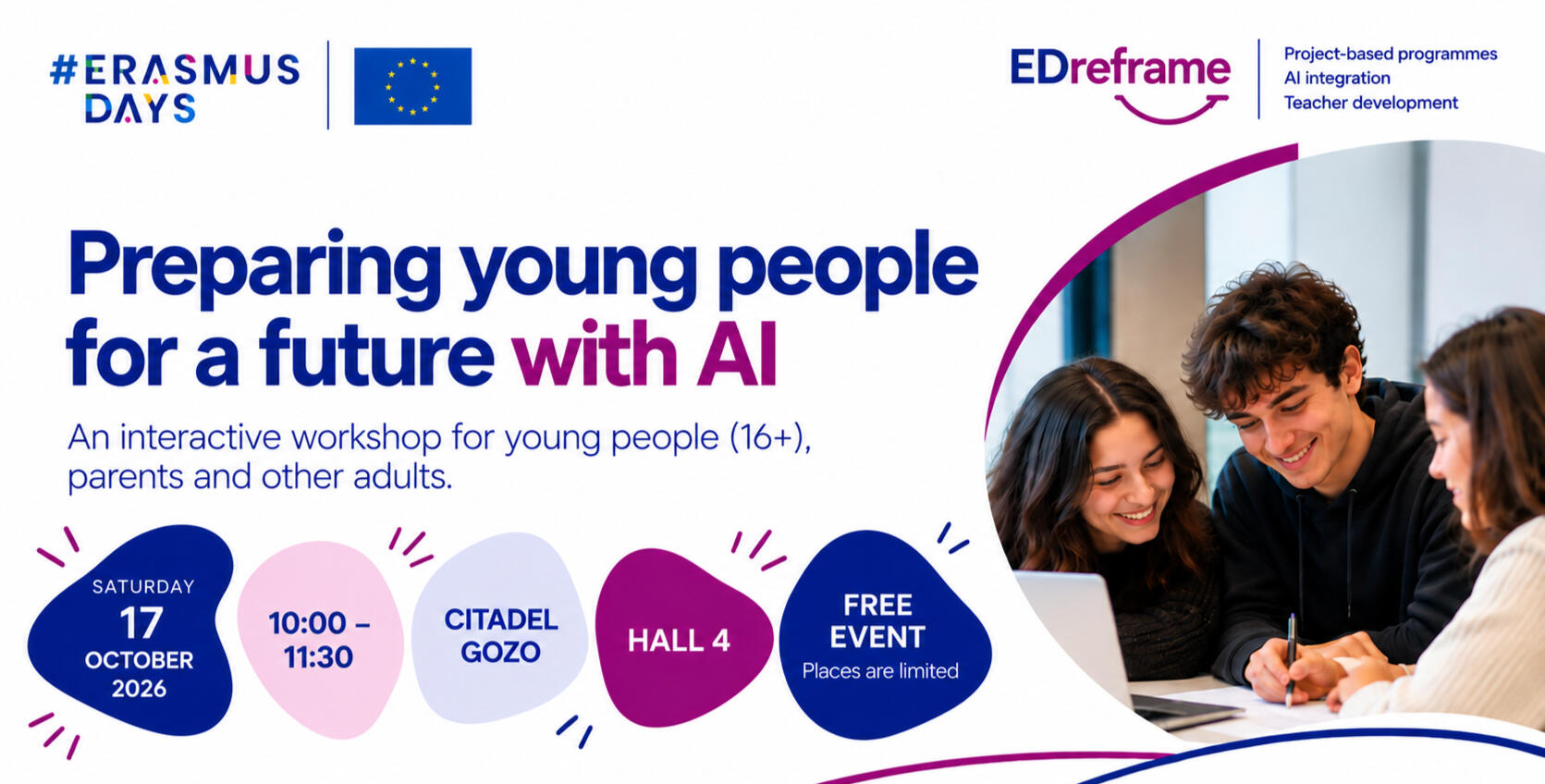
Preparing young people for the future is not about choosing between humans and AI. It is about learning to think, collaborate and make responsible decisions in a world where AI is always available.
What you'll do
During this interactive workshop, participants will:✔ Experience the same challenge with and without AI
✔ Compare human thinking and AI-generated ideas
✔ Discover when AI helps and when human judgement matters
✔ Collaborate with others to solve a real-world problem
✔ Reflect on what education looks like in an AI-enabled world
Why attend?
AI is changing education, work and everyday life. Discover how to think critically, collaborate and make responsible decisions in a world where AI is always available.
Who is it for?
Young people (16+), parents, and anyone curious about how AI is changing education, learning and work.
| Who | When | Where | Cost |
|---|---|---|---|
| Young people (16+) and parents | Saturday, 17 October 2026 | 10:00–11:30 | Hall 4, The Citadel, Gozo | Free |
Places are limited. Reserve your free place today.
About EDreframe
EDreframe is an educational consultancy that designs project-based programmes, supports responsible AI integration, and develops educators to prepare learners for an AI-enabled world.
Learn more at www.edreframe.com
How to Assess Writing When Learners Use AI
A 90-minute workshop for educators and training managers who teach writing or support colleagues with writing assessment, and want to strengthen learner autonomy.
Workshop overview
Explore three writing lesson models using AI and shared assessment criteria. Experience activities as a learner, examine them as an educator, and consider how to apply them in your own context.Activities use complaint emails as the writing example, with discussion of adaptations for other contexts.
Aims and learning outcomes
By the end of the workshop, participants will be better able to:- Choose a lesson model for their context and explain how they would adapt it.- Use shared assessment criteria to guide AI-assisted feedback and writing revision.- Identify opportunities, limitations and adaptations when supporting learners’ use of AI.
Workshop stages
- Writing assessment challenges: Discuss the challenges participants face when learners use AI.- Model 1 - AI gives personalised feedback: Use AI to generate feedback on writing based on set assessment criteria.- Model 2 - Learner-developed criteria: Explore how learners build shared assessment criteria before writing an email.- Model 3 - AI-assisted peer feedback: Explore how learners use AI and shared criteria to prepare feedback for a classmate.- Reflection and Q&A: Discuss which model you would use, why, and what you would adapt.
Who is it for?
Teachers, educators and training managers interested in writing assessment, learner autonomy and the use of AI in learning.
Minimum requirements
- Your own computer and a stable internet connection.- Basic digital literacy and some experience using AI.- Access to an AI tool that accepts text prompts. No specific platform is required.
Fees, location and dates
Workshop fee: €38 per participant
Duration: 90 minutes
Location or online platform: Online (details will be shared once registration is confirmed)
Date and time: 31 October 2026, 09:00–10:30 (CEST, UTC+2). Time-zone details
Delivery language: English
Group size: 3–10 participants. If fewer than three people register, the workshop will be rescheduled and registered participants will be notified of the new date.
Assessment and certification
Learning is reviewed through a closing discussion: participants explain which model suits their context, why, and what adaptations may be needed.Participants receive a certificate of attendance.
Facilitator
Sondes Gharbi holds the Cambridge DELTA (Level 7) and an MBA (Level 7). She is an ELT Council accredited trainerand has completed Cambridge English Train the Trainer.Through EDreframe, she delivers professional-development workshops on writing assessment when learners use AI, task-based lesson planning, debate and among other courses and workshops. Her approach brings participants into the learning process: they experience activities as learners, examine the teaching decisions behind them, and explore adaptations for their own contexts.View facilitator experience and credentials
Feedback from previous participants
The lesson models were well thought through. We had time to experience as students and reflect on them as experts. I need to practice them in the upcoming lessons/ months. Marjia K, Malta (teacher)I now have more confidence to use AI in class with my students. I would love to attend future workshops on how to use AI and give learners more autonomy over their learning. Gina G, Malta, (teacher)Turns out that the lessons require students to think critically about their writing and AI input & output. I see how I can plan CPDs and help teachers be more confident when using AI in their lessons, with their students. I highly recommend this workshop. Clint C, school manager, Malta
For further information or to discuss training for your team, email [email protected] to arrange a consultation.
How to Use AI as a Debate Tool and Debating Partner
A 90-minute workshop for educators and training managers who want to explore speaking, argumentation and critical thinking through AI-supported debate.
Workshop overview
Experience two approaches to using AI in speaking activities: as a rehearsal partner and as a debate opponent. Prepare arguments, practise speaking without reading AI responses, and examine how to adapt the activities for your learners.The examples focus on B1 English learners aged 15+, with discussion of adaptations for other levels and teaching contexts.
Aims and learning outcomes
By the end of the workshop, participants will be better able to:- Use prompts to set up AI as a rehearsal partner and debate opponent.Structure spoken arguments with a clear claim, supporting reason and example.- Identify scaffolding and adaptations that encourage learners to speak in their own words.- Recognise risks of copying, reading from the screen and over-reliance on AI.
Workshop stages
- Speaking challenges: Discuss the challenges that arise when learners use AI in speaking lessons.- Preparing arguments: Explore the classroom context and a simple structure for clear arguments.- AI as a rehearsal partner: Use AI to prepare ideas and practise responding to questions, then rehearse aloud without reading directly from the screen.- AI as an opponent: Work with a partner to defend a position and respond aloud to AI’s written challenges.- Reflection and Q&A: Discuss the support learners need, the limitations of each activity and adaptations for your context.
Who is it for?
Teachers across subjects, teacher trainers and academic or training managers interested in speaking activities, debate and learners’ independent thinking.
Minimum requirements
- Your own computer and a stable internet connection.- A working microphone for participation in online speaking activities.- Basic digital literacy and some experience using AI.- Access to an AI tool that accepts text prompts. No specific platform is required.Activities use written AI responses alongside participants’ spoken contributions.
Fees, location and dates
Workshop fee: €38 per participant
Duration: 90 minutes
Location or online platform: Online (details will be shared once registration is confirmed)
Date and time: 7 November 2026, 09:00–10:30 (CET). Time-zone details
Delivery language: English
Group size: 3–10 participants. If fewer than three people register, the workshop will be rescheduled and registered participants will be notified of the new date.
Assessment and certification
Learning is reviewed through closing discussions. Participants explain which approach they prefer, which would work best in their context, why, and what adaptations may be needed.Participants receive a certificate of attendance.
Facilitator
Sondes Gharbi holds the Cambridge DELTA (Level 7) and an MBA (Level 7). She is an ELT Council accredited trainerand has completed Cambridge English Train the Trainer.Through EDreframe, she delivers professional-development workshops on writing assessment when learners use AI, task-based lesson planning, debate and among other courses and workshops. Her approach brings participants into the learning process: they experience activities as learners, examine the teaching decisions behind them, and explore adaptations for their own contexts.View facilitator experience and credentials
Feedback from previous participants
Feedback from the IATEFL session: “…the session balanced AI’s role as coach and challenger without letting it overshadow the learner’s own reasoning and voice…” Ridha Mejri, Senior Lecturer, GermanyFeedback from the MATEFL session: “…her workshop offered several useful ideas for integrating AI in ways that place critical thinking at the centre of the learning process while also helping to maintain learner engagement.” Matt Done, EFL Teacher, Malta
For further information or to discuss training for your team, email [email protected] to arrange a consultation.
How to Deliver Constructive Peer Feedback with AI
A 90-minute workshop for teachers, teacher trainers and school leaders who want to help learners deliver clear, constructive feedback with confidence.
Workshop overview
Giving useful peer feedback involves more than identifying strengths and mistakes. It requires clear explanations, a respectful tone and suggestions the recipient can act on.This interactive workshop explores how AI-supported practice can be used to rehearse and reflect on feedback delivery. Experience the challenges from a learner’s perspective and consider how to help students communicate feedback thoughtfully, while keeping their own judgement central.The focus is on feedback that is specific, constructive and relevant to your learners’ needs.
Aims and learning outcomes
By the end of the workshop, participants will be better able to:- Prepare feedback on writing or speaking using provided assessment criteria.- Deliver structured feedback that recognises strengths, explains areas for improvement and suggests next steps.- Review AI’s feedback on their delivery and decide which suggestions to apply.- Identify adaptations and limitations when using the approach with their learners.
Workshop stages
1. Introduction2. Round 1: Prepare, deliver and review3. Round 2: Apply and practise4. Reflection and Q&AExplore adaptations and limitations for your teaching context.
Who is it for?
Teachers across subjects, teacher trainers, and school leaders or training managers responsible for teaching and learning.The focus is on helping learners give constructive peer feedback on writing or speaking.
Minimum requirements
- Your own computer and a stable internet connection.- A working microphone for participation in online speaking activities.- Basic digital literacy and some experience using AI.- Access to an AI tool that accepts text prompts. No specific platform is required.Activities use written AI responses alongside participants’ spoken contributions.
Fees, location and dates
Workshop fee: €38 per participant
Duration: 90 minutes
Location or online platform: Online (details will be shared once registration is confirmed)
Date and time: 14 November 2026, 09:00–10:30 (CET, UTC+2). Time-zone details
Delivery language: English
Group size: 3–10 participants. If fewer than three people register, the workshop will be rescheduled and registered participants will be notified of the new date.
Assessment and certification
Learning is reviewed through closing discussions. Participants explain which approach they prefer, which would work best in their context, why, and what adaptations may be needed.Participants receive a certificate of attendance.
Facilitator
Sondes Gharbi holds the Cambridge DELTA (Level 7) and an MBA (Level 7). She is an ELT Council accredited trainerand has completed Cambridge English Train the Trainer.Through EDreframe, she delivers professional-development workshops on writing assessment when learners use AI, task-based lesson planning, debate and among other courses and workshops. Her approach brings participants into the learning process: they experience activities as learners, examine the teaching decisions behind them, and explore adaptations for their own contexts.View facilitator experience and credentials
Feedback from other EDreframe workshops
Feedback from the IATEFL session: “…the session balanced AI’s role as coach and challenger without letting it overshadow the learner’s own reasoning and voice…” Ridha Mejri, Senior Lecturer, GermanyFeedback from the MATEFL session: “…her workshop offered several useful ideas for integrating AI in ways that place critical thinking at the centre of the learning process while also helping to maintain learner engagement.” Matt Done, EFL Teacher, Malta
For further information or to discuss training for your team, email [email protected] to arrange a consultation.
How to Give Constructive Feedback to Students with AI
A 90-minute workshop for teachers, teacher trainers and academic managers who want to explore using general-purpose AI tools to support feedback on writing and speaking.
Workshop overview
Explore how to guide general-purpose AI tools to produce feedback informed by your assessment criteria. Working with writing samples and speaking transcripts, examine both human and AI-generated feedback and practise requesting clearer, more relevant responses.Develop a checking process to decide what you can use, what needs editing and what needs reassessing. Reflect on whether the approach could help with your own feedback workload.
Aims and learning outcomes
By the end of the workshop, participants will be better able to:- Guide AI to draft feedback using the task, learner context and assessment criteria.- Evaluate human and AI-generated feedback for accuracy, relevance and useful suggestions.- Refine AI’s instructions and responses to address omissions, unsupported judgements and unclear advice.- Decide which feedback to use, edit or reject, and assess the practical value of the approach in their context.
Workshop stages
1. Introduction- Explore the purpose of feedback and the role of assessment criteria.2. Round 1: Guide, compare and refine - Examine feedback and practise guiding AI’s responses.3. Round 2: Apply and review- Apply your learning to another task and review the results.4. Reflection and Q&A- Discuss usefulness, workload, adaptations and limitations.
Who is it for?
Teachers across subjects, teacher trainers, and school leaders or training managers responsible for teaching and learning.The focus is on helping learners give constructive peer feedback on writing or speaking.
Minimum requirements
- Your own computer and a stable internet connection.- A working microphone for participation in online speaking activities.- Basic digital literacy and some experience using AI.- Access to an AI tool that accepts text prompts. No specific platform is required.Activities use written AI responses alongside participants’ spoken contributions.
Fees, location and dates
Workshop fee: €38 per participant
Duration: 90 minutes
Location or online platform: Online (details will be shared once registration is confirmed)
Date and time: 21 November 2026, 09:00–10:30 (CET, UTC+1). Time-zone details
Delivery language: English
Group size: 3–10 participants. If fewer than three people register, the workshop will be rescheduled and registered participants will be notified of the new date.
Assessment and certification
Learning is reviewed through activity discussions and a closing reflection. Participants explain which feedback they would use, edit or reject, why, and what adaptations may be needed in their context.Participants receive a certificate of attendance.
Facilitator
Sondes Gharbi holds the Cambridge DELTA (Level 7) and an MBA (Level 7). She is an ELT Council accredited trainerand has completed Cambridge English Train the Trainer.Through EDreframe, she delivers professional-development workshops on writing assessment when learners use AI, task-based lesson planning, debate and among other courses and workshops. Her approach brings participants into the learning process: they experience activities as learners, examine the teaching decisions behind them, and explore adaptations for their own contexts.View facilitator experience and credentials
Feedback from other EDreframe workshops
Feedback from the IATEFL session: “…the session balanced AI’s role as coach and challenger without letting it overshadow the learner’s own reasoning and voice…” Ridha Mejri, Senior Lecturer, GermanyFeedback from the MATEFL session: “…her workshop offered several useful ideas for integrating AI in ways that place critical thinking at the centre of the learning process while also helping to maintain learner engagement.” Matt Done, EFL Teacher, Malta
For further information or to discuss training for your team, email [email protected] to arrange a consultation.
How to Plan a Task-Based Lesson: 21st-Century Skills in the Era of AI
A four-hour online workshop for teachers, teacher trainers and academic managers who want to design task-based lessons that connect learning with real-world communication, collaboration and purposeful AI use.
Workshop overview
In this hands-on workshop, you will first experience a task-based lesson as a learner before stepping back to analyse its design as a teacher. You will then plan a task-based lesson for an existing unit, receive peer feedback and refine it for your own teaching context.AI is integrated into the task itself: learners use AI to gather initial information and then verify claims against relevant sources found through web research.
Aims and learning outcomes
By the end of the workshop, participants will be better able to:- Plan a lesson for an existing unit, integrating real-world communication, scaffolding, collaboration, problem-solving and decision-making alongside purposeful AI use.- Guide students to use AI for initial research and verify AI-generated claims against relevant web sources.- Share lesson plans and use peer feedback to refine them.- Identify likely implementation challenges and plan possible solutions for their own contexts.
Workshop stages
Session 1 - 28 November | 09:00–11:00 CET
Experience the task → analyse the lesson → reflect on the role of AI and 21st-century skills → begin planning your own task-based lesson.Session 2 - 5 December | 09:00–11:00 CET
Develop your lesson → share and discuss plans → receive peer feedback → refine your design → share implementation challenges and planned solutions for your context.
Who is it for?
Teachers across subjects, teacher trainers, and school leaders or training managers responsible for teaching and learning.
Minimum requirements
- Basic familiarity with lesson planning and teaching methodology- Basic familiarity with AI tool use- A laptop or computer with internet access- Access to an AI tool and web search- An existing coursebook unit or lesson they would like to adapt
Fees, location and dates
Workshop fee: €100 per participant
Duration: 4 hours total (2 × 2-hour sessions)
Location or online platform: Online (details will be shared once registration is confirmed)
Date and time: 28 November & 5 December 2026 at 09:00–11:00 CET on both dates (CET, UTC+1). Time-zone details
Delivery language: English
Group size: 3–10 participants. If fewer than three people register, the workshop will be rescheduled and registered participants will be notified of the new date.
Assessment and certification
Learning is reviewed through activities, discussion and a closing reflection.
Participants explain how they would use their task-based lesson in their own context and what adaptations they would need to make.
Participants receive a certificate of attendance displaying the ELT Council accreditation code.
Facilitator
Sondes Gharbi holds the Cambridge DELTA (Level 7) and an MBA (Level 7). She is an ELT Council accredited trainerand has completed Cambridge English Train the Trainer.Through EDreframe, she delivers professional-development workshops on writing assessment when learners use AI, task-based lesson planning, debate and among other courses and workshops. Her approach brings participants into the learning process: they experience activities as learners, examine the teaching decisions behind them, and explore adaptations for their own contexts.View facilitator experience and credentials
Feedback from other EDreframe workshops
“An eye-opening, empowering experience from start to finish.” - Patricia Portillo, CEO, CHOICE Learning Center“We experience[d] the session from both the teacher’s and the learner’s perspective… which made the sessions more impactful and practical.” - Hela Aguerbi, English Educator & School Coordinator
For further information or to discuss training for your team, email [email protected] to arrange a consultation.
PROjects modules

| PROjects modules | What learners do | What skills become visible |
|---|---|---|
| Create Your Podcast | Learn how to script, record, collaborate, and publish your own podcast episode. | Research and source evaluation; question design; teamwork; interview skills; audience awareness; editorial decision-making |
| Pitch Your Idea | Turn a real-world problem into a creative solution and pitch it like a startup idea. | Problem framing; solution design; evidence-based reasoning; decision-making; persuasive communication; responding to feedback |
| Organise Your Charity Event | Plan, promote, and coordinate a meaningful event together as a team. | Planning and coordination; role allocation; stakeholder engagement; teamwork; accountability; civic contribution |
| Create Your Brand's Website | Design and present a simple website around a topic, idea, or project. | Audience and user awareness; information selection and organisation; digital publishing; visual communication; ethical use of online content |
| Create Your Reel | Plan, film, and edit a short-form reel designed for social media storytelling and creative expression. | Storyboarding & storytelling; audience awareness; creative decision-making; digital-media production; revision through feedback |
| Create Your Social Media Campaign | Design content, visuals, captions, and creative campaign ideas around a real topic or cause. | Campaign planning; message design; media literacy; evidence selection; ethical communication; evaluating audience response |
Across all modules, the recurring capabilities are:
- research and source evaluation
- planning and self-management
- collaboration and responsibility
- decision-making and justification
- audience and stakeholder awareness
- digital and media literacy
- reflection, feedback and revision
- responsible AI use, where AI is included
These are illustrative module formats.
Each can be adapted to an institution’s curriculum, learner group, context and intended real-world challenge.
EDreframe is open to commissioned pilots, programme-development work and Erasmus+ Cooperation Partnerships.
EDreframe is open to new partnerships and collaborations in Europe.We are looking to connect with reliable, accountable partners interested in developing learning initiatives that enable adults and young people to contribute to real community, social or environmental challenges.Through EDreframe, we design and pilot project-based programmes that connect learning with relevant people, organisations and real-world contexts.
Potential areas of collaboration include:
- Adult and youth participation
- Employability and lifelong learning
- Non-formal education
- Digital and media literacy
- Community engagement and active citizenship
- Environmental learning and local actionWe can contribute through curriculum and programme design, piloting and evaluation, teacher and facilitator development, and learning approaches that make communication, collaboration, decision-making and critical thinking visible.We value transparent communication, clearly agreed responsibilities and follow-through on commitments.We are open to Erasmus+ consortium partnerships, other funded initiatives, and commissioned educational projects.If there may be a fit, please contact us at [email protected] or visit www.edreframe.com.
Testimonials
Helping institutions redesign learning and assessment for AI-mediated education.
Feedback from workshops delivered through international conferences and teacher development events, including IATEFL, MATEFL, and face-to-face and online CPD sessions.
"…the session balanced AI’s role as coach and challenger without letting it overshadow the learner’s own reasoning and voice…”
Attended the "How to Use AI as a Debate Tool and Debating Partner" at IATEFL
“…her workshop offered several useful ideas for integrating AI in ways that place critical thinking at the centre of the learning process while also helping to maintain learner engagement.”
Attended the "How to Use AI as a Debate Tool and Debating Partner" at IATEFL
“This workshop showed me the steps I had missed and why speaking publicly in English is difficult for young people.”
Attended the "How to Teach Presentation Skills" in a face-to-face workshop
“I enjoyed an enriching experience on the use of task-based learning (TBL). Sondes skillfully guided us towards the session’s objectives while maintaining a dynamic and interactive environment.”
Attended the "How to Plan a Task-Based Lesson: 21st-Century Skills in the Era of AI" online
“The methodology in the task-based learning is both comprehensive and highly effective. Her approach is grounded in clarity, practicality and economy, making it valuable for busy corporate environment.”
Attended the "How to Plan a Task-Based Lesson: 21st-Century Skills in the Era of AI" online
“Sondes makes complex pedagogical concepts feel actionable and relevant for today’s language classrooms. Her workshops are practical, inspiring and deeply engaging.”
Attended the "How to Plan a Task-Based Lesson: 21st-Century Skills in the Era of AI" online
“There were 3 activities that can be unpacked in lesson plans with some tweaking. Most importantly, I now have the confidence to use AI in my lessons with my students.”
Attended the "How to Assess Writing When Learners Use AI" at MATEFL